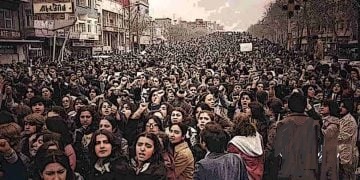
Iranian women experience discrimination in law and in practice in ways that deeply impact their lives, particularly with regard to marriage, divorce and custody issues. Post-1979 compulsory hijab laws affect virtually every aspect of women’s public life in Iran. In today’s Iran, a woman’s access to employment, education, social benefits and proper health care — and even her mere public presence in society— depends on complying with compulsory hijab laws, which are routinely enforced through a web of rules and arbitrary interpretation by state agents as well as businesses.
However, despite its overarching impact on women’s rights and freedoms, the choice of dress code as a right was not taken up by Iran’s women’s movement as a collective issue until recently. Instead, the battle against enforcement of the compulsory wearing of the hijab was largely fought by the individual acts of millions of women, including activists, across the country – rather than via groups or institutions.
Iran has a decades-long history of movements promoting women’s rights, both before and after the revolution of 1979. Most of them pursued a vision of equality under law and sought to redress the gap regarding legal protection by promoting international human rights instruments. The most notable example after the revolution is the coalition of Islamist and secular feminist activists who came together to establish the “One Million Signature Campaign to Demand the Repeal of Discriminatory Laws” in 2006.
Focus issues included age discrimination in establishing criminal responsibility and marriageable age, inequality in inheritance and discrimination of mothers as guardians in case of divorce. The issue of the compulsory hijab was notably absent. While the “One Million Signature Campaign” did not achieve its stated goal of fully repealing the set of relevant laws, it created strong bonds among students and labor activists and trained a generation of activists in legal advocacy. Similar to other movements, this group of activists came under significant state pressure and faced large-scale arrests during the Ahmadinejad presidency.
The pressure on the movement combined with the repression that followed the 2009 presidential election protests increasingly foreclosed avenues for legal reforms and led dozens of human rights defenders and activists to go into exile. It also shifted the focus of women’s rights defenders towards promoting women’s representation, including the presence of women in public life.
During the presidency of Hassan Rouhani, Shahindokht Molaverdy, the then-vice president for women and family affairs and a figure close to the women’s rights movement, came under immense pressure from the judiciary to prevent any such change and was only able to take minor steps in advancing women’s rights. During this period, the women’s movement focused most of its activities on achieving more representation in elected positions, greater women’s attendance of sporting events, and better protection against sexual harassment in public as well as work spaces.